Showing posts with label learner. Show all posts

Monday, March 3, 2014

Classroom 2.0

   Talking about Classroom 2.0, "This website is really doing it seriously.", that's what came into my mind
when I was filling in my applying information. The website requires me to give the reason why I want to join this network. "Wow, that's something I never expect." Then the administrator will decide whether you can join this network. What does this mean? This means this website is really specifically  professional; the members on this network are all real professional in this field. Because they are qualified for such a standard.
    And it really is professional. You can explore various educational resources on the site; it provides literature, videos for new teachers which are really helpful to widen their horizon. Within this site, it also forms a network among teachers from all over the world. From the view of connectivism, this is definitely a huge resource to learn from if you fully enrolled in it.
   I

What’s mine is yours!


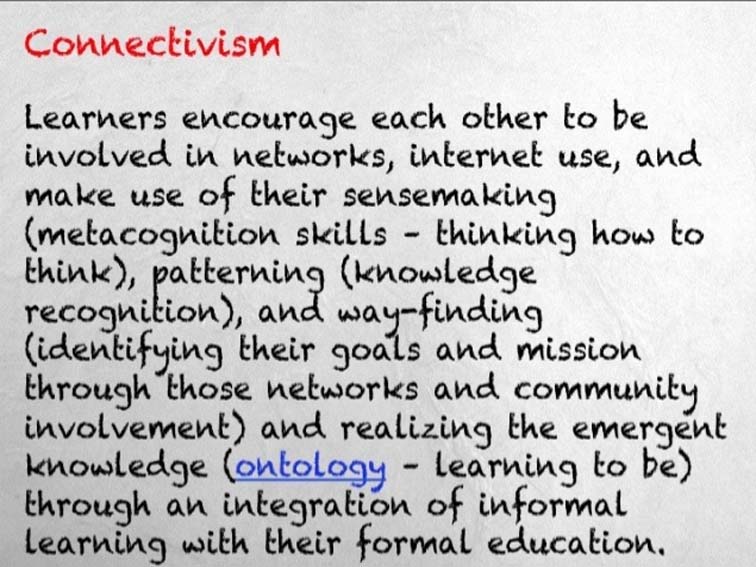
    This is an era of information explosion. Siemens G. mentioned the extent that the knowledge expanding in Connectivism: A Learning Theory for the Digital Age. One of the most persuasive factors is the shrinking half-life of knowledge. The “half-life of knowledge” is the time span from when knowledge is gained to when it becomes obsolete. Half of what is known today was not known 10 years ago.” In other way to think about this, what you have learned now will not satisfy you in 10 years. We need to absorb knowledge and refresh our minds as quickly as we can to keep pace with the changing world. The traditional way of learning won’t fit; you may never think about this, we learned a lot through on-line network through the last decades. We are a new type of learners, the connectivism learners. What is connectivism? "The relationship between work experience, learning, and knowledge, as expressed in the concept of ‘connectivity, is central to connectivism, motivating the theory's name.” The central aspect of connectivism is the metaphor of a network with nodes and connections.  In this metaphor, a node is anything that can be connected to another node such as an organization, information, data, feelings, and images.


So, learners are like sponges in a big vessel full of knowledge of water. Every sponge will absorb certain part or amount of knowledge at first as we start to learn knowledge. Then we squeeze the water out as we share knowledge with others. In this process, the knowledge will mix and maybe create more chemistry as motivate new ideas and then be absorbed by others again. This ‘absorb-squeeze-absorb’ process happens among every sponge thus creates a multi-linked network. Through the network exchanging knowledge, we share information and learn new stuffs from others. Back to reality, this network exists in our internet technology. Today our connections base on social networks such as Facebook and twitter connect us more efficiently. The network is learning, isn't it? Being educators, we should make advantages of all these technology to instruct our next generation learn in a fast-pace world.
    And one more things to mention, when you read this, you’ve already become a connectivism learner!